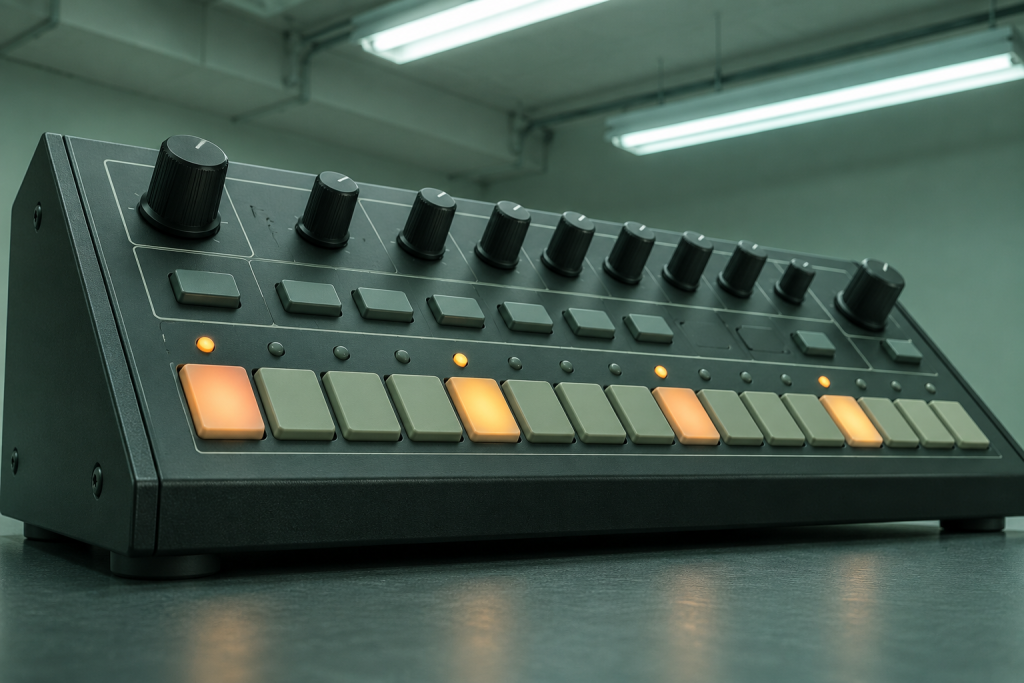
Six boxes, one drum loop, same source every time. That is the only way I trust a saturation plugin. Play a break through a chain, tweak three knobs, print it, compare. Everything else is marketing.
I ran a loop from a d’n’b classic (the Think break, obviously) plus a parallel acoustic kick-and-snare bus through a shortlist of saturation tools that cost less than a decent takeaway. The brief: does it add weight, or just fizz? Here is what survived.
How I tested
Same session, same buffer, no master processing. The loop went into a clean bus at -18 dBFS average peak. Each plugin inserted one at a time, gain-matched with a VU so I was not fooled by loudness. I listened for transient integrity (kick still punches), harmonic texture (does it sound like a box or like noise), and whether the low end survives. Drums expose everything. A plugin that flatters a synth pad will fall apart on a snare.
One more rule: none of these are on the master. Drum bus only. If it needs a mix knob pushed past 40% to do anything, it is not a saturation box, it is a distortion pedal.
1. Soundtoys Devil-Loc Deluxe
This one is not subtle. It is an emulation of the Shure Level-Loc, a hardware limiter from the 1960s that studios used as a secret weapon for smashing drums. Controls are crush (compression), crunch (saturation), slow/fast release, darkness, and mix. That is it. No oversampling switch, no fancy metering.
On the drum bus at roughly 30% mix, it does something nothing else in this price band does: it glues the break into a single object. The snare tail gets crushed into the kick, and the whole loop starts breathing. Push crunch past halfway and it stops pretending to be a compressor and just destroys. Great for a loop you want to sound like a sample of a sample. Bad for a bus you want to keep clean. The mix knob saves it.
Verdict: buy it if you make breakbeat-derived music. Skip it if your drums need to stay polite.
2. Variety of Sound FeenstaubTC
Windows only. That is the first thing you need to know, and it will disqualify it for half of you. VoS plugins have never gone Mac, and that has not changed. But FeenstaubTC is the closest thing to a free tape-and-tube channel strip I have used on drums.
It is part tube compressor, part saturation. On the drum bus it adds a soft, rounded weight that sits under the kick rather than over it. The harmonics are dense but not spiky, which is what you want for a loop that plays for eight bars without fatigue. The compressor section is gentle and does not fight the bus compressor downstream.
Verdict: if you are on Windows, this is free and it belongs on your drum bus. If you are on Mac, move on.
3. Kiive Audio S-Quick Strip
Not a pure saturation box, but at the price it keeps showing up in sales it deserves a slot. It is a channel strip with saturation, EQ, compression, a transient shaper, high-pass, and mix controls, and it is fast to dial in. I used it as a saturation-first tool: transient shaper off, EQ flat, compression barely touching, saturation doing the work.
What I like is the mix control. You can dial in 20% saturation and keep the transient shape of the original loop. On the acoustic bus it added a mid-forward grit that sat well against the electronic kick. The downside is cognitive: too many knobs, and you start tweaking when you should be listening. I set it once per session and left it.
Verdict: the most versatile tool on this list. The least focused.
4. FabFilter Saturn 2 (tube setting)
Saturn 2 is not under $50 at full price. If it is in your bundle or on sale, though, the tube algorithm is the reason to load it on a drum bus. I split the processing into three bands, kept the mids on the warm tube setting, used warm tape on the highs to keep them present without harshness, and let the lows stay closer to clean. The linear phase option lets the distortion sit without smearing the transients, and high quality mode oversamples to reduce aliasing.
That multiband control is what separates Saturn from the single-knob boxes. You can saturate the snare band without making the kick flabby. It is also the most work to set up. Two minutes of routing before you hear anything.
Verdict: overkill for one drum bus. Essential if you process drums this way every session.
5. MKS Mixing DelayU-42 (used as a saturation box)
This one is a delay plugin, but the developer documented the trick themselves: set feedback to zero, delay time to 0 ms, drive the signal hard, and dial in the wet/dry balance to pull off the squeeze and grit while the repeats stay silent. That is the whole reason it is on this list. It costs nothing.
The saturation is dark and gritty, modeled after 80s rack delays, and it has an opto-limiter that reacts as you push the input harder. On the drum bus at low mix it rounds off the top end and adds a smeared, vintage texture. It does not add weight the way FeenstaubTC does, and it will not replace a real saturation tool. But as a texture device it works, and the price is right.
Verdict: a clever free texture box. Not a primary saturation stage.
6. Soundtoys Devil-Loc (the compressed one, not Deluxe)
Wait. Same family. Skip this if you already own the Deluxe, the extra controls on the Deluxe are worth it, and it is not a separate purchase worth making. If you are building from nothing and the Deluxe is out of budget, the base version does the core crush-and-crunch job without the mix control, which means you commit harder to the sound. On a parallel drum bus that is actually fine. On the main bus, the missing mix knob hurts.
Verdict: only if the price gap is real and you work in parallel.
What I actually kept on the bus
Two plugins rode the session through to the end: FeenstaubTC at low settings for weight, and the Devil-Loc Deluxe at 30% mix for glue. Everything else was a texture decision made per loop. That is the plain truth. Saturation is not a chain slot you fill once. It is a set of tools you reach for based on what the break is missing. A loop that already has harmonics needs less than a sterile one-shot kit.
The other thing I noticed: the drum samples themselves matter more than any of this. A drum pack that has already been saturated through real analog gear, like the old Samplephonics tube collections, leaves far less work for the plugin chain. Start with good source material and half of these boxes are optional. Start with dry one-shots and you will be reaching for the top of the list.